Custom software development

Connect your systems. Once_
and for good

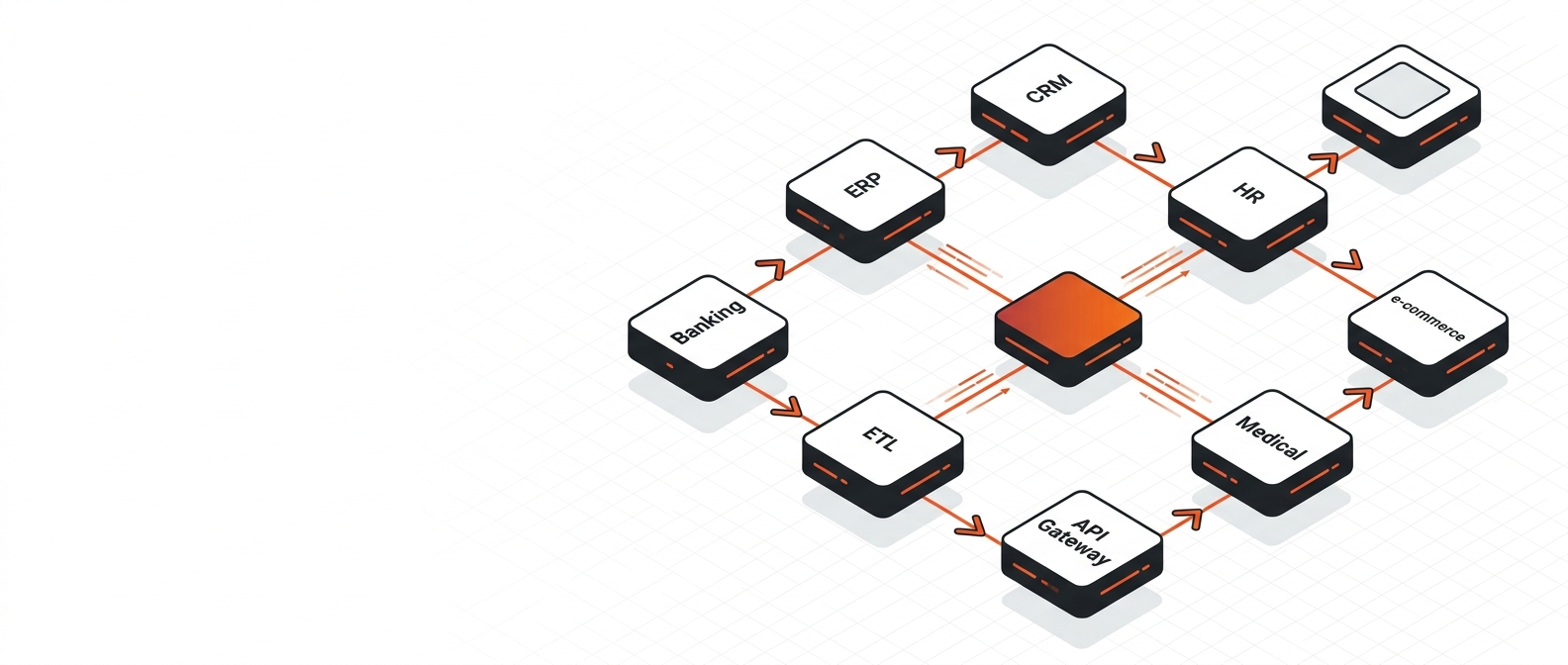
We integrate ERP, CRM, HR, healthcare, banking systems, e-commerce, and payment gateways and KSeF— eliminating data silos and manual work. 20 years of experience in environments where mistakes are costly. Projects for mBank, Medicover, TUI, and Millennium Leasing.

20+
years on the market
150+
delivered projects
75%
client retention
Get a project estimate_
✓ Thank you! Your message has been sent. We'll respond within 24 business hours.
🔒 Your data is safe · We respond within 24h
Trusted by_
Logo mBanku
Logo TUI
Logo Medicover
Logo Centrum Medyczne Damiana
Logo Invimed
Logo Ediny
Logo NordPartner
Logo Snickers
Logo Stroeer
Logo IgoriaCard
Logo Ovoria
Logo Orange
Logo Deutsche Bank
Logo Ministerwsa Rolnictwa i Rozwoju Wsi
Logo Lays
Logo Raiffeisen Leasing
Logo Credit Agricole
Logo Born Donor Bank
Logo Oney
Logo mBanku
Logo TUI
Logo Medicover
Logo Centrum Medyczne Damiana
Logo Invimed
Logo Ediny
Logo NordPartner
Logo Snickers
Logo Stroeer
Logo IgoriaCard
Logo Ovoria
Logo Orange
Logo Deutsche Bank
Logo Ministerwsa Rolnictwa i Rozwoju Wsi
Logo Lays
Logo Raiffeisen Leasing
Logo Credit Agricole
Logo Born Donor Bank
Logo Oney
01 · Problem framing

Data islands cost you more than you think_

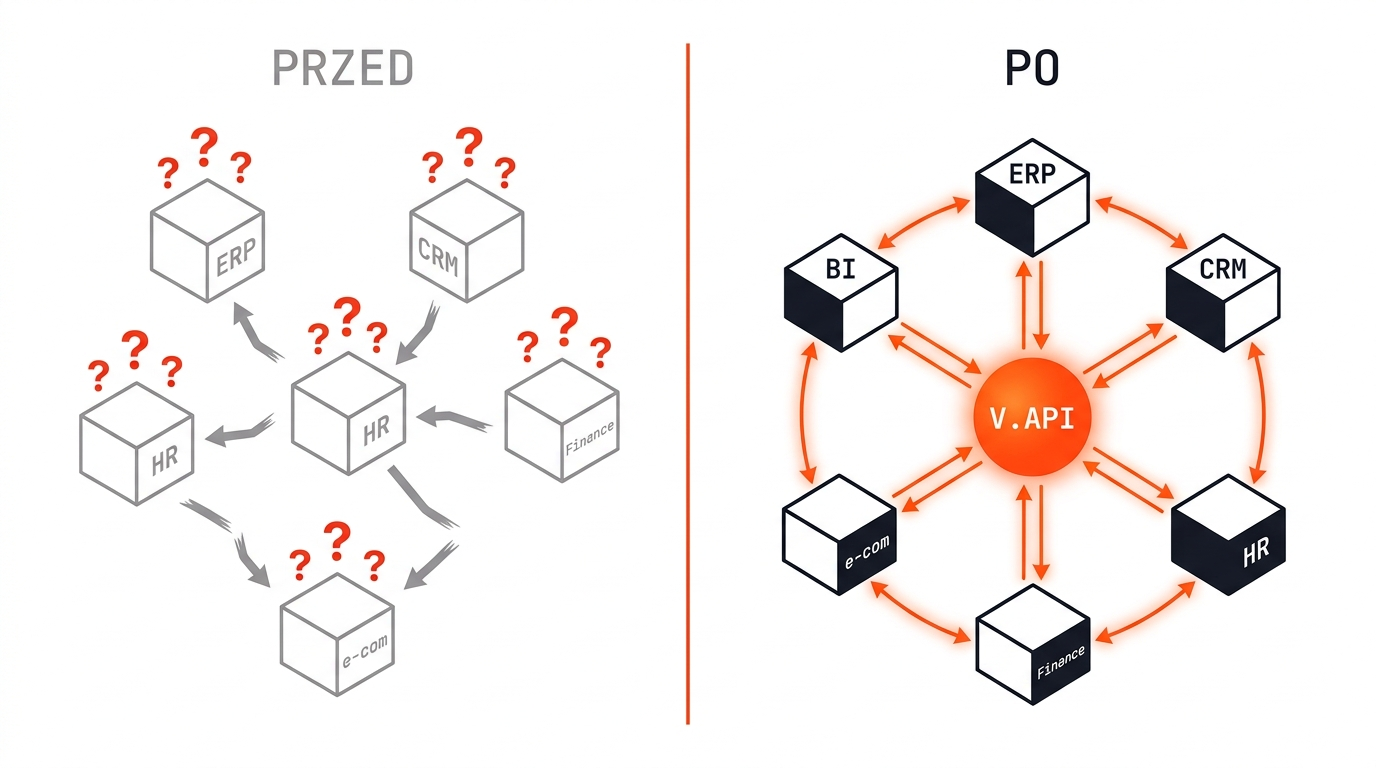
IT system fragmentation — known as data silos — affects companies of every size. Employees lose hours manually re-entering information between incompatible applications, and you lose money on errors, delays, and missed opportunities.

Manual data entry

The team spends hours re-entering information between systems instead of focusing on higher-value business tasks. Every manual step is a potential error.

No consistent view of the customer

The customer is asked for the same information multiple times. Personalizing offers and building long-term relationships becomes impossible. Frustration on both sides.

Reports from multiple sources

Creating comprehensive reports requires gathering data from different sources — a tedious, error-prone process that often leads to poor management decisions.

Poor data quality affects decision quality

According to industry data, the average company loses up to 12% of annual revenue to data fragmentation and manual processes. Systems integration eliminates these risks, ensuring information consistency from source to management report.

12%
annual losses from silos
3-5×
faster reporting
02 · Definition

What is IT systems integration_

IT systems integration is the process of connecting different IT systems, applications, and databases to create a unified and consistent operational environment.

The main goal is to ensure smooth data exchange between systems, eliminate information duplication, and automate business processes.

This allows organizations to achieve higher efficiency, reduce operational costs, and improve the quality of decisions based on consistent, up-to-date data.

Types of integration
A2A — Application to Application

Connecting different applications within a company (ERP ↔ CRM ↔ HR) so information flows without human intervention.

Data-level integration

Ensures information consistency across different databases — a single source of truth for the entire organization.

BPM — business process integration

Connecting end-to-end processes, e.g. from an order in a store all the way to accounting in ERP and warehouse shipment.

Integration with external systems

Communication with suppliers, banks, insurance companies, or payment systems (PSD2, KSeF).
03 · Integration methods

Three proven approaches to systems integration_

Each method has its use case. After the audit, we recommend an approach tailored to your scale, budget, and regulatory requirements.

METHOD / 01

Integration via API

Application Programming Interface — the most popular and effective method for integrating IT systems. Uses defined interfaces for automatic data exchange between applications, eliminating manual re-entry.

Ideal for ERP, CRM systems and mobile applications requiring real-time synchronization. API architecture supports building flexible, scalable solutions.

REST SOAP gRPC GraphQL
METHOD / 02

Integration platforms and middleware

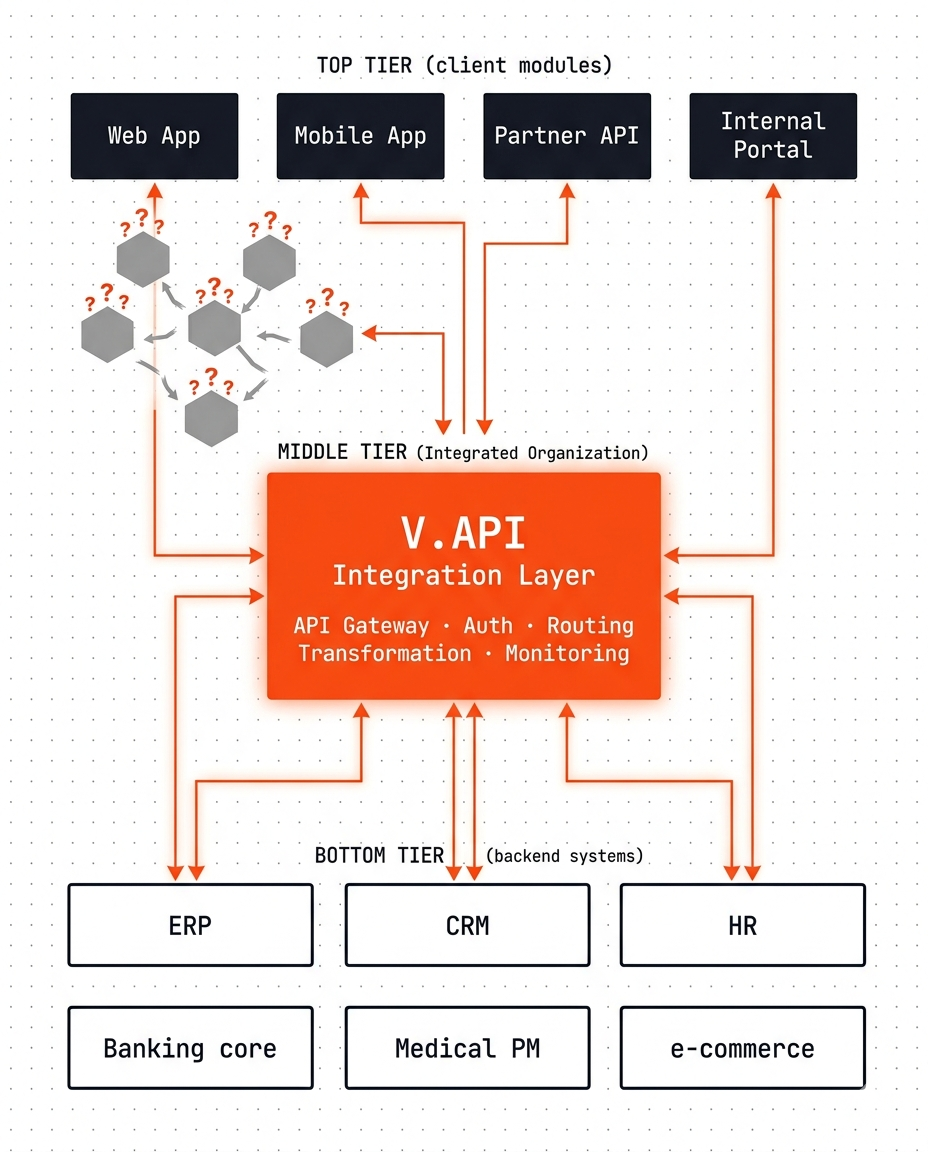
Software that mediates between different applications. Simplifies integration with ready-made tools for managing data flow, format transformation, and operation monitoring.

ESB (Enterprise Service Bus) type middleware enables centralized integration management — reduces maintenance costs and speeds up the deployment of new connections. Recommended for complex corporate environments.

ESB iPaaS V.API ETL/ELT
METHOD / 03

Event-driven architecture

Event-driven architecture — systems communicate through asynchronous events (e.g. a new transaction, customer update).

EDA is particularly effective in environments requiring high scalability, flexibility, and real-time processing. Ideal for fintech, e-commerce, and booking systems.


Apache Kafka RabbitMQ Webhooks Pub/Sub
04 · Architecture

Architecture built to last for years_

A properly designed architecture is the foundation of effective integration — it affects flexibility, scalability, and fault tolerance. We always choose the model based on business goals, not technology trends.

Types of integration
Service-Oriented Architecture

Classic approach with clearly defined services. Works well in corporate environments with many legacy systems.

Microservices

Independent, scalable components. Ideal for modern platforms and projects requiring rapid iteration.

Event-Driven Architecture

Asynchronicity and real-time processing. Essential for fintech, e-commerce, and high-event-volume platforms.
Technology stack
We design all integrations with the highest privacy and auditability standards in mind.
.NET Vue.js React REST SOAP gRPC Apache Kafka RabbitMQ PostgreSQL MS SQL Azure Docker Kubernetes V.API
Security and compliance
We design all integrations with the highest privacy and auditability standards in mind.
GDPR ISO 27001 PSD2 KSeF SSO / SAML
05 · Specialization

Payment and finance integration_

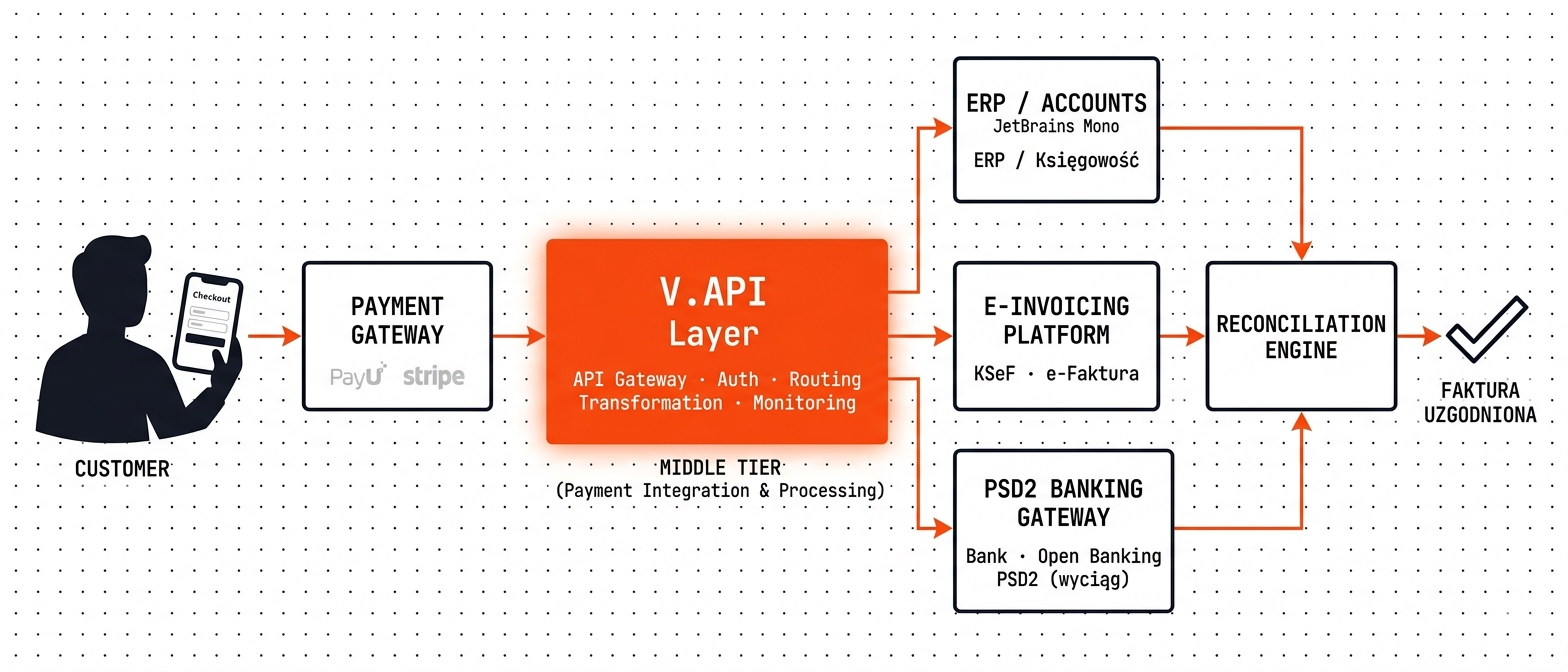
Money doesn't forgive mistakes. We integrate payment gateways, banking systems, KSeF, and split payment mechanisms — with auditability required by regulators and accounting departments.

01 / GATEWAYS

Payment gateways

Integration with PayU, Przelewy24, Stripe, Adyen, Tpay, Blue Media. Cards, BLIK, installments, recurring payments.

PayU Stripe P24
02 / OPEN BANKING

Open Banking PSD2

AIS and PIS — account access, payment initiation, retrieving bank statements. Full PSD2 compliance.

AIS PIS Polish API
03 / E-INVOICES

KSeF e-invoices

National e-Invoice System — issuing, sending, and receiving structured invoices. We have experience with volumes of 50,000+ invoices annually.

KSeF API FA(2) XAdES
04 / SPLIT PAYMENT

Split payment mechanism

MPP support, VAT taxpayer whitelist, automatic VAT amount extraction to a VAT account. Compliance with tax law.

MPP Whitelist JPK
05 / RECONCILIATION

Payment reconciliation

Automatic matching of payments to invoices and bookings. Handling deposits, additional payments, refunds. Eliminating manual reconciliation.

Auto-match MT940 CAMT

Payments in action
real numbers_

Three integration projects where we handle real financial flows — daily, in production.

50 000
e-invoices annually · Medicover

The Self Billing system issues, sends, and archives invoices in a full cycle, integrated with accounting.

850K+
payments · TUI

Deposits, additional payments, refunds — integration with online payment gateways and bank statements.

8 TU
calculators · Millennium

Automation of payment handling and reporting new insurance policies to insurers.

06 · Implementation process

5 steps to a working integration we work_

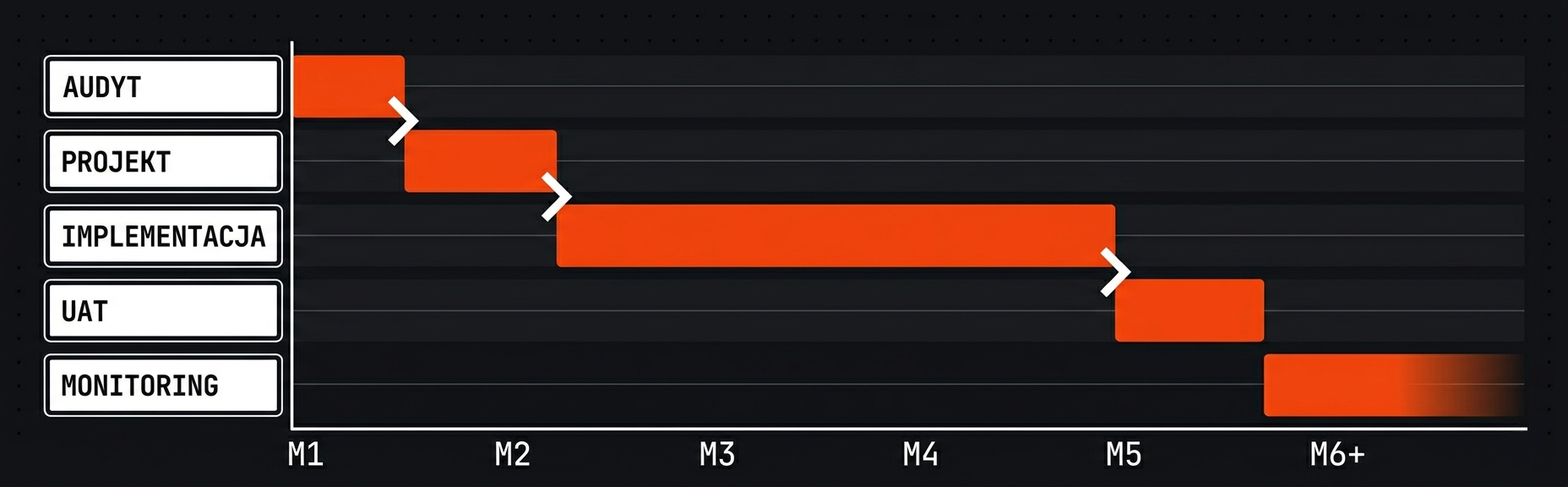
We work according to a plan that is both structured and flexible. We ensure transparent communication and stay in constant contact with your team. The project doesn't end for us with implementation.

01
Audit of current systems

We analyze the architecture, identify integration points, and map data flow. We detect systems without APIs.

02
Solution design

We define the target architecture, technologies, timeline, and KPIs. Technical spec tailored to regulations.

03
Iterative implementation

We work in sprints. Every module undergoes regression testing. We deliver working components every 2-4 weeks.

04
UAT and phased rollout

User Acceptance Testing with the business client. Deployment with rollback capability — we minimize production risk.

05
Monitoring and maintenance

Continuous monitoring of data flow, SLA, incident response, development planning. Full service support.
08 · Costs and ROI

An investment that
pays for itself quickly_

Integration costs are often seen as a barrier, but in reality it's an investment with a measurable return.
Long-term benefits from smooth data flow and process automation significantly outweigh the initial expenses, leading to increased efficiency and business competitiveness.

How we minimize costs
Middleware platforms

Ready-made connectors and tools reduce expenses by 30-40% compared to building from scratch.

Phased implementation

Spreads costs over time and allows monitoring ROI after each module.

Proprietary V.API platform

Shortens time-to-market and reduces implementation costs. Proven in 150+ projects.

Types of integration
-60%
Time on manual processes

Eliminating data copying between systems

 
3-5x
Faster reporting

One source of truth for the entire organization

 
-85%
Data errors

Validation at the integration level, not human

 
25%
Increase in sales efficiency

Consistent customer view = better personalization

 
09 · Support and maintenance

Integration isn't a project.
It's a continuous process_

After deployment, the real work begins: monitoring data flow, optimization, adapting to changing regulations and business needs. Our SLA agreements guarantee fast response, incident management, and integration development planning. 3 out of 4 clients continue working with us — because our software actually works.

What support includes
24/7 monitoring

Continuous monitoring of data flow and integration performance

Incident response

Fast identification and resolution of issues according to SLA

Updates and regulations

Adapting to GDPR, KSeF, PSD2 changes — without downtime

Performance optimization

Quarterly audits, bottleneck identification, refactoring

User training

Team onboarding, documentation, knowledge transfer

10 · Industries

Experience across 6 regulated industries_

We specialize in environments where an integration error carries real business and legal risk.

Fintech & Banking

mBank, Oney, BPS · PSD2 compliance

Healthcare

Medicover, CM Damiana · GDPR + HIPAA

Leasing

Millennium, Raiffeisen, EFL, BOŚ

Insurance

Nord Partner, Oney · 8 insurer calculators

Travel & e-commerce

TUI · 200 offices, 850K+ customers

11 · FAQ

Frequently asked questions_

Everything worth knowing before starting an integration project.

The duration depends on project complexity, the number of systems to integrate, and API availability in existing applications. Small integration projects can take a few weeks. More complex integrations involving multiple ERP, CRM, or banking systems take from several months to a year. Thanks to our iterative approach and proven methods, we aim to optimize costs while maintaining the highest quality. The audit is the first step toward a precise timeline.
Usually not — that's one of the biggest advantages of our approach. Our integration methods focus on leveraging available APIs and middleware platforms that act as an intermediary layer between different systems. If a system doesn't have a good API, we can apply dedicated solutions: custom connectors, data adaptations, or an abstraction layer. The goal is to create smooth data flow without the need for costly rebuilding of core software.
We use a wide range of modern technologies tailored to the project:
API & communication REST, SOAP, gRPC, GraphQL, Webhooks for real-time communication.
Event-driven : message queues Apache Kafka, RabbitMQ — for high scalability and event processing.
Data transformation : ETL/ELT tools for database and data warehouse synchronization.
Proprietary our V.API platform shortens time-to-market and reduces implementation costs, ensuring robust data flow.
Yes — it's one of our specializations. We integrate:
Payment gateways: PayU, Przelewy24, Stripe, Adyen, Tpay, Blue Media — cards, BLIK, installments, recurring payments.
Open Banking PSD2: AIS (account information access), PIS (payment initiation), retrieving MT940/CAMT statements.
KSeF: issuing, sending, and receiving structured e-invoices (FA(2), XAdES). We have experience with volumes of 50,000+ invoices annually.
Split Payment Mechanism: MPP support, VAT taxpayer whitelist checking, automatic VAT amount extraction. For TUI we handle deposits, additional payments, and refunds with integration to online payment gateways and bank statements — over 850,000 customers served.
The cost depends on several factors: complexity of existing systems, number of integration points, chosen technologies, and project scope. Expenses include: licenses for integration platforms, developer work, consulting, testing, and training. Using middleware and phased implementation can significantly reduce costs. After a free audit, we provide a specific quote and ROI estimate. Request an audit — we'll respond within 48 hours.
Yes. Security and compliance are the foundations of every integration project. All our solutions are designed with the highest standards in mind: GDPR, ISO 27001, PSD2, KSeF.
This includes access management (SSO, identity federation), data encryption in transit and at rest, and regular security audits. Process auditability is key to maintaining full transparency.
This is a common scenario, especially in legacy environments. We have several proven approaches:
Custom connectors: we create a dedicated intermediary layer that understands the old system's format and translates it to a modern API.
Database-level integration: direct synchronization at the database level with CDC (Change Data Capture) mechanisms.
Robotic Process Automation (RPA): in exceptional cases, we automate the user interface when no other method is possible.
We offer flexible support models, including SLA agreements with guaranteed response times. Support includes: 24/7 data flow monitoring · Incident management · Performance optimization · Updates resulting from regulatory changes · Integration development planning · User training. 3 out of 4 of our clients continue long-term collaboration — that's our best recommendation.
12 · Let's talk

Let's discuss your project_

Within 24 business hours we'll reach out with a proposal for an initial, no-obligation consultation. We don't sell — we advise. This is the first step to understanding whether Veloce is the right partner for your organization.
  • Free 30-minute consultation with a senior developer and business analyst
  • Initial feasibility assessment, technology recommendations, and budget estimate
  • NDA signed before discussing any details about your business
  • No sales pressure — you can simply benefit from our expertise

Get a project estimate_

✓ Thank you! Your message has been sent. We'll respond within 24 business hours.
🔒 Your data is safe · We respond within 24h